Decorative Candle Centerpiece with Red A
First Impressions: Warm, Layered, and Ready for Real Stitching
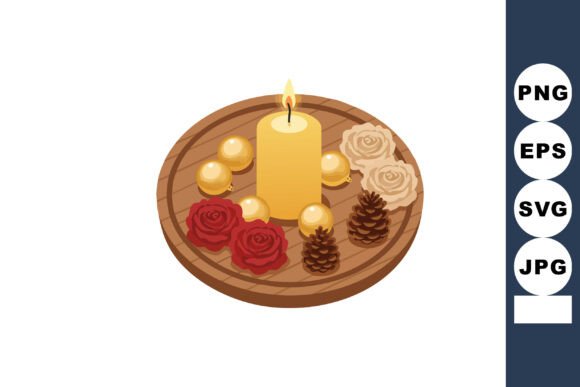
When I opened Decorative Candle Centerpiece with Red a, my immediate thought wasn’t “pretty vector”—it was “this will stitch beautifully on a linen tea towel.” The composition feels intentional: a centered candle radiates soft focus, while red and beige roses, pine cones, and golden balls orbit it like quiet holiday guests. There’s rhythm in the asymmetry—no rigid symmetry here—and the wooden plate base grounds the whole thing. It’s not overly detailed, but it’s not minimal either. That balance is rare. As an embroidery designer who tests dozens of Illustrations monthly, I know this kind of visual warmth translates directly into perceived handmade value—especially for Etsy sellers crafting personalized gifts or boutique kitchen collections.
A Real-World Test: Embroidering It on a Linen Pillow Cover
Last week, I stitched Decorative Candle Centerpiece with Red a onto a 16x16” natural linen pillow cover for a client’s holiday boutique line. Why linen? Because its subtle texture mirrors the wood grain implied in the design—and because it’s a common fabric for high-end home goods. I used medium-weight cutaway stabilizer, 40-weight rayon thread (burgundy, cream, gold, forest green), and a 5x7” hoop. The result? Crisp satin-stitched petals, clean fill-stitched pine cones, and golden balls that read as dimensional—not flat blobs. Customers noticed the *intentional spacing*: no overcrowding, no stitch collisions. That’s critical. Too many holiday embroidery files cram elements together, forcing dense stitch density that puckers thin fabrics. This one breathes.
Where It Shines—And Where to Pause
- Custom apparel: Works best on relaxed-fit sweatshirts and structured tote bags—fabrics that hold shape under moderate stitch density. Avoid tight-knit tees unless you reduce size by 15–20% and simplify inner details.
- Baby embroidery & nursery decor: Soft color palette makes it gentle for baby blankets or onesies—but test small roses first; their curves need at least 1.5mm minimum line width to digitize cleanly.
- Embroidered patch: Excellent candidate. The defined outer shape and balanced negative space mean clean laser-cutting or heat-applied backing. Just confirm your digitizer preserves the candle’s glow effect using subtle underlay.
- Holiday gifts & personalized products: Its cozy mood reads instantly—no explanation needed. Perfect for monogrammed kitchen towels or wedding welcome pillows (swap red for blush if needed).
- Small shop product & Etsy listing: Stands out in mockups. Pair it with warm-toned lifestyle photos—not sterile white backdrops. Buyers connect with *mood*, not just motif.
Fabric & Fit Notes You Can’t Skip
Don’t assume Decorative Candle Centerpiece with Red a behaves the same on every surface. On stretchy fabric like French terry, the candle flame detail blurred slightly without tear-away + cutaway combo stabilizer. On dark fabric, I swapped gold thread for metallic bronze—it popped better and avoided a washed-out look. And on curved surfaces like baseball caps? I repositioned it lower on the front panel and avoided the crown seam entirely. The pine cones’ texture reads well even at 3.5”, but the smallest golden balls need careful digitizing—if your embroidery file doesn’t include separate small-object settings, ask your digitizer to isolate them for lighter fill stitch.
What It Does for Your Craft Business—Beyond the Stitch
This isn’t just another Graphics download. It elevates perception. When customers see this on a handmade apron or embroidered sweatshirt, they don’t see “holiday clipart”—they see curation, intention, and seasonal storytelling. That builds trust. For Etsy sellers, it increases average order value: pair it with matching napkin sets or printable gift tags, and buyers add more. For craft fair vendors, it’s a conversation starter—“Is that a real candle?” “Nope—just really good stitch placement.” That human connection matters. And for digital product sellers bundling embroidery assets? Include a simple black-and-white version for print-on-demand mockups. It converts better than full-color previews.
Practical Designer Checks Before You Stitch
- Test on scrap fabric *first*—especially if using textured weaves or blends.
- Review thread color contrast: red roses fade on burgundy fabric unless you boost saturation or switch to matte cotton.
- Confirm hoop size fits your machine’s largest frame—and whether the design’s outer diameter leaves ½” margin for hooping stability.
- Inspect corners and curves: do pine cone scales hold definition at your intended size? Zoom in on the SVG/EPS before digitizing.
- Run a black-and-white mockup: does the candle’s glow still read as light source, or does it disappear?
- Compare light vs. dark fabric backgrounds—some gold threads lose luster on charcoal unless you use core-spun metallics.
- Use proper stabilizer: cutaway for knits, tear-away for stable wovens, and always float for delicate layers like silk-blend tea towels.
- Verify licensing: since this is sold as a machine embroidery design asset, confirm commercial use rights apply to finished products *and* digital resale if you’re bundling it.
Final Thought: Mood Is the First Stitch
Decorative Candle Centerpiece with Red a works because it understands context. It doesn’t shout. It settles in—like a well-placed centerpiece on a holiday table. That’s why it succeeds across so many uses: embroidered patch, sweatshirt embroidery, baby embroidery, holiday embroidery, even commercial embroidery for boutique branding. It’s not flashy. It’s thoughtful. And in a market flooded with over-digitized, oversaturated designs, that restraint is its strongest feature. Use it where warmth matters most—and let the stitching do the rest.